
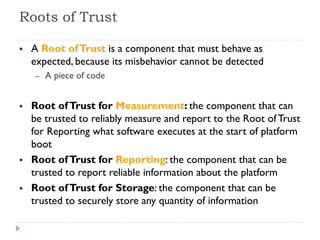
If the hashes match, the RoT executes the verified element, passing trust to it. If the hashes don’t match, the RoT stops the boot process, signaling a compromise. This failure state prevents the system from loading a potentially malicious environment.
- This separation is crucial for sustaining a recovery path and making certain that the reporting of the system’s state remains accurate.
- It doesn’t resolve whether every measurement is suitable or whether software behaves safely.
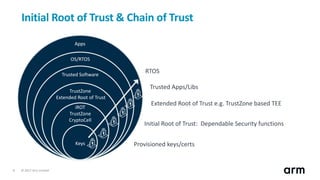
- It serves as the base trusted software that then authenticates and validates the next piece of software loaded, which establishes a chain of belief.
- Securing IoT gadgets is important to guard the gadget makers status with consumers and companies.
- A firmware assault targets the firmware of a device, which is a software program that tells the device (computer, smartwatch, or smartphone) the method to operate when powered on.
Gadget Identification
It doesn’t manufacture or independently certify the hardware root, platform firmware, authenticator, or attestation service. Operators must decide which roots, vendors, evidence, freshness, and lifecycle states meet their access requirement. Bind every key to 1 objective, coverage, platform state, and authorized caller. Plan substitute when hardware, firmware, algorithms, ownership, or trust policy changes.
WireGuard, IPsec, and TLS purchasers can retailer their personal keys within the TPM (via PKCS#11) and require a measured-boot PCR coverage to make use of them. A compromised OS can not extract the vital thing; an unmeasured boot can not use it. Hardware RoT is operationally helpful provided that the boot chain extends trust from the silicon up through firmware, bootloader, kernel, and userspace. A protection PKI with no documented and audited key ceremony is a defense PKI with a single level of insider failure. Thales Luna HSMs, Entrust nShield, Utimaco SecurityServer, and AWS CloudHSM dominate the network-HSM market. Every offers PKCS#11, KMIP, and (typically) a proprietary higher-level SDK.
Trusted Platform Module (tpm)
Name the primary instruction or key, who provisions it, how a verifier authenticates it, and which later components it can measure or authorize. Define vendor, producer, firmware, supply-chain, enrollment, ownership-transfer, replace, revocation, and end-of-life assumptions. Last time, the primary focus was that the system needs to have hardware-based isolation to create a secure processing setting (SPE) and a nonsecure processing environment (NSPE).
Producers must integrate specific chips and develop complex firmware to manage the RoT lifecycle. Moreover, if the RoT itself is flawed or improperly manufactured, the compromise is impossible to remediate without replacing the hardware. This permanence makes the preliminary design and validation of RoT components critically important. It signifies the ultimate source of trust in a system’s security structure. Just as a ship relies on its anchor to remain positioned, a safe computing system depends on the Trust Anchor to confirm its state.
Embedded at the silicon stage, an RoT supplies a safe foundation for all other security operations inside a system. It ensures that even in the presence of potential vulnerabilities, the system can operate in a trusted environment. Whereas it might not get as a lot consideration as its software counterparts, hardware security is vitally important in modern systems. It performs a vital function in establishing trust, defending sensitive knowledge, and enhancing system performance. Make certain to retailer sensitive credentials and keys in tamper-resistant, isolated hardware methods, safeguarded with software program and physical security measures.
Use Cases And Applications
The strongest approach combines hardware-backed belief with patching, certificates administration, endpoint policy enforcement, monitoring, and incident response. In PKI, hardware-backed identification helps prove that a certificate belongs to an actual, trusted system. This is particularly helpful for enterprise endpoints, IoT gadgets, servers, and managed cellular gadgets that want robust authentication.
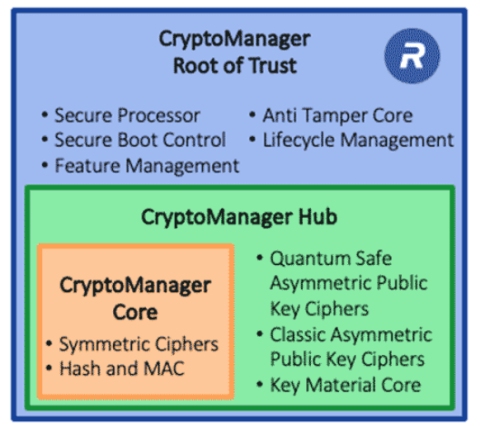
It relies on the TPM’s capability to securely measure the platform’s state, generate signed attestation knowledge, and allow remote entities to confirm the integrity and authenticity of that knowledge. The use of attestation enhances safety in scenarios corresponding to safe boot, distant gadget management, and safe communication between gadgets. The Root of Belief is the inspiration of a safe system, offering a beginning point for establishing belief. It is often a hardware-based element or set of parts which might be inherently trusted. The RoT ensures the integrity and security of a system from the beginning of the boot process.
Securing IoT units is crucial to protect the system makers status with consumers and businesses. More And More it’s also lined by regulation, regulation and requirements so safety can’t be added as an afterthought. A root of belief in an exterior hardware authenticator that can be utilized with any computer or cellular gadget to determine that the particular person accessing an account is the rightful owner. The Tock kernel is compiled particularly for a specific https://imorphosis.com/iot-in-retail-for-successful-business-transformation/ hardware device, termed a board. Any time you need to compile the kernel or edit the board file, you’ll go to that folder.
Platforms corresponding to Hexnode can support organizations by serving to implement gadget security posture, configuration policies, and compliance requirements around trusted endpoints. Full-disk encryption keys, application-tier secrets and techniques, and cross-domain credentials are sealed to PCR policies. The system unseals them mechanically on a known-good boot – no user-typed passphrase – they usually remain unreachable on a tampered or unauthorized boot. Construct artifacts for operational software program are signed by an HSM-resident key, typically as the final step in a DevSecOps zero-trust pipeline. The signing key by no means leaves the HSM; the CI/CD system authenticates to the HSM via mTLS and submits hashes for signing. Mixed with a verifiable SBOM, this provides downstream verifiers a cryptographically anchored software provide chain.